Author: Marblism Integration

  • Event Venue Profitability: 9 Proven Strategies to Increase Revenue and Maximize Your Margins

    Event Venue Profitability: 9 Proven Strategies to Increase Revenue and Maximize Your Margins

    Owning a venue is a dream for many, but running a profitable one is a rigorous business challenge. If you find yourself looking at a busy calendar but a thin bank account, you aren't alone. Many operators fall into the "revenue trap": focusing on how many bookings they have rather than the actual event venue profit margins left over after the lights go out.

    In 2026, the landscape of event space financial management has shifted. It’s no longer enough to just "rent the room." To achieve true event venue business growth, you must stop thinking like a landlord and start thinking like a yield manager. Every square foot and every hour of the day is an asset that needs to be optimized for maximum return.

    Whether you operate a rustic barn, a chic banquet hall, or a modern loft, these nine strategies will show you how to make money with an event venue while working smarter, not harder.


    1. Implement Dynamic Pricing and Minimum Spends

    The most common mistake in venue pricing strategy is having a static price list. If your Saturday night in June costs the same as a Thursday in November, you are leaving thousands of dollars on the table.

    The Strategy: Transition to a "Core + Flex" pricing model. Charge a premium for high-demand dates (Saturdays, holidays, and peak seasons) and set a minimum total spend (venue rental + F&B + add-ons) for these prime slots. This ensures that your busiest nights are also your most profitable.

    Pro Tip: For off-peak dates, don't just "discount." Instead, offer "value-add" packages that include services that have a high perceived value but low cost to you, such as early load-in times or a complimentary champagne toast.


    2. Diversify Your Revenue Streams Beyond Weddings

    While weddings are the "bread and butter" for many, relying solely on wedding venue income creates a feast-or-famine cycle. Successful operators look for ways to increase event venue revenue by filling the 250+ days a year that aren't Saturdays.

    Revenue Builder Workflow in Venue Builder

    The Strategy: Actively market to corporate and community groups. Mid-week corporate retreats, leadership workshops, and networking mixers are high-margin because they typically require less "hand-holding" than a wedding. Community events like wine tastings, holiday markets, or craft fairs can turn your space into a local destination while keeping the cash flowing during slow months.

    Action Item: Use a tool like the Venue Revenue Builder to generate specific event concepts for your slowest months.


    3. Maximize Revenue Per Booking with High-Margin Add-ons

    If you only sell the space, you are missing out on the most profitable part of the event industry: the experience. To maximize venue revenue, you must increase your average booking value through strategic upsells.

    The Strategy: Create a "Menu of Experiences." This could include:

    • Upgraded AV Packages: For corporate clients who need seamless hybrid meeting tech.
    • Premium Bar Programs: Offering local craft spirits or custom signature cocktails.
    • Ceremony Upgrades: Premium seating, arbor rentals, or "ready rooms" with stocked fridges.
    • Late-Night Snacks: A simple "taco bar" or "pizza station" at 11:00 PM is a high-margin crowd-pleaser.

    Pro Tip: Incorporate these add-ons into your initial tour. If couples see the "VIP Lounge" during their first visit, they are 40% more likely to book it than if you offer it a month before the wedding.


    4. Master the Micro-Wedding and Small Event Market

    Large gala events are great, but the overhead: staffing, cleaning, and wear and tear: is massive. In 2026, "micro-events" have become a secret weapon for banquet hall profitability.

    Event Blueprint for a S'mores Night

    The Strategy: Design a "Turnkey Micro-Package" for groups of 20–50. These events can often be scheduled on Sundays or weeknights and require 70% less labor. Because the guest count is low, you can charge a premium per person for a high-end, intimate experience, resulting in much higher event venue profit margins than a low-cost 200-person wedding.


    5. Optimize Venue Operations Efficiency

    Profitability is as much about what you keep as what you make. High operational costs are the "silent killer" of venue businesses.

    The Strategy: Focus on venue operations efficiency by cross-training your staff. A team member who can handle social media marketing during slow hours and act as a day-of coordinator during events is significantly more valuable than two specialized part-time employees. Additionally, audit your energy usage; switching to smart HVAC systems and LED lighting can reduce utility overhead by up to 25% annually.

    Key Strategy: Automate your lead management. Using AI-driven venue marketing software allows you to respond to inquiries instantly, increasing your lead-to-tour conversion rate without needing a full-time sales person.


    6. Build Strategic (and Profitable) Vendor Partnerships

    Your "Preferred Vendor List" is more than just a resource for clients; it’s a business development tool.

    The Strategy: Move beyond simple referrals. Negotiate "referral commissions" or "marketing fees" with high-end vendors like caterers and florists who benefit from being on your exclusive list. Alternatively, bundle their services into your all-inclusive packages and take a management fee. This simplifies the process for the client and adds a new wedding venue revenue stream for you.


    7. Leverage the Power of the Bar Program

    For venues with a liquor license, the bar is your highest-margin department. If you aren't managing it tightly, you are losing money every time a drink is poured.

    The Strategy: Implement strict inventory controls and "Bar Minimums." Instead of a "consumption-only" model where guests might not drink much, require a minimum spend. This guarantees your revenue and covers your staffing costs regardless of the crowd's energy. Additionally, push "Tiered Bar Packages": most clients will opt for the "Gold" or "Premium" level if the value difference is clearly articulated.


    8. Focus on Lead-to-Tour Conversion Rates

    You can spend thousands on ads to boost venue bookings, but if your sales funnel is leaky, that money is wasted. Your venue management tips aren't complete without a focus on the "closing" process.

    Venue Dashboard for Performance Tracking

    The Strategy: Track your data religiously. You should know exactly how many leads it takes to get one tour, and how many tours it takes to get one booking. If your tour-to-booking rate is below 30%, your "the vibe" might be off, or your pricing might be confusing. Use a dashboard to monitor these KPIs (Key Performance Indicators) monthly.

    Action Item: Read our guide on How to Market a Wedding Venue to refine your lead generation strategy.


    9. Use AI to Fill the Calendar While You Sleep

    The most successful venue owners in 2026 aren't the ones working 80 hours a week; they are the ones leveraging technology.

    The Strategy: Use an AI business assistant like Venue Builder to automate your content creation and event ideation. Instead of spending hours staring at a blank screen, you can generate an entire month of social media posts, email newsletters, and blog articles in minutes. This consistency keeps your venue "top of mind" for planners and couples, ensuring your booking velocity remains high year-round.


    Conclusion: Stop Dreaming, Start Scaling

    Increasing your venue profitability isn't about one big change; it’s about a dozen small optimizations. By diversifying your events, tightening your operations, and embracing modern technology, you can build a business that doesn't just survive but thrives.

    Ready to see how many dates you can fill? Check out our 100 Wedding Venue Marketing Ideas to get started.


    FAQ: Common Questions on Venue Profitability

    Q: What is a "good" profit margin for an event venue?
    A: While it varies by location and venue type, a healthy event venue profit margin typically falls between 15% and 30%. All-inclusive venues often have lower margins but higher total revenue, while "blank canvas" rentals have lower revenue but much higher margins.

    Q: How can I increase revenue without raising my base rental price?
    A: Focus on add-ons and "Experience Packages." Upsells like late-night food, premium lighting, or bridal suite upgrades can add 10–20% to your total booking value without scaring away price-sensitive clients with a high base fee.

    Q: What is the most profitable type of event?
    A: Corporate events and micro-weddings often have the highest ROI. Corporate clients are less price-sensitive and book during the week, while micro-weddings allow you to charge high rates with very low overhead and staffing requirements.

    Q: How often should I review my venue's pricing?
    A: At a minimum, review your venue pricing strategy annually. However, in a high-demand market, you should evaluate your "booking velocity." If you are booking dates too quickly (e.g., 18+ months in advance), your prices are likely too low.

  • How to Get More Venue Bookings Without Spending a Dime on Ads

    How to Get More Venue Bookings Without Spending a Dime on Ads

    If you are like most venue owners, your marketing budget is likely under a microscope. You see competitors pouring thousands of dollars into Facebook ads and high-ticket marketplace listings, and you wonder: Is that the only way to fill my calendar?

    The short answer is no. In fact, relying solely on paid ads is a dangerous game. It creates a "pay-to-play" dependency where the moment you stop spending, the leads stop coming.

    As an expert who has consulted with hundreds of venues, I can tell you that some of the highest-performing venues in the industry today are doing so by leveraging organic, zero-cost strategies that build long-term authority and sustainable lead flow. In 2026, planners are more savvy than ever; 90% of event planners use social media to find and vet venues, and they can spot a generic paid ad from a mile away.

    This guide will show you exactly how to capture those leads without spending a single dime on advertising.

    1. Optimize Your "Digital Front Door": Google Business Profile

    Before a couple or a corporate planner ever visits your website, they are likely searching for "[Your City] event venue" or looking at Google Maps. Your Google Business Profile (GBP) is your most powerful free marketing tool.

    Most venue owners "set it and forget it." To dominate local search, you must treat your GBP as a living, breathing portfolio.

    • Complete Every Attribute: Don't just list your address. Ensure you’ve checked every box for accessibility (ADA compliance), amenities (WiFi, air conditioning), and event types.
    • The Power of Seasonal Photos: Upload new photos at least once a month. Show your venue in the spring, the winter, and during a corporate seminar vs. a wedding gala.
    • Google Updates: Use the "Update" feature to post about open dates, new catering partners, or recent renovations. Google loves active profiles and will reward you with higher rankings in the "Local Pack."

    Pro Tip: Respond to every review, even the good ones. A thoughtful response to a 5-star review tells prospective clients that you are attentive and value your customers.

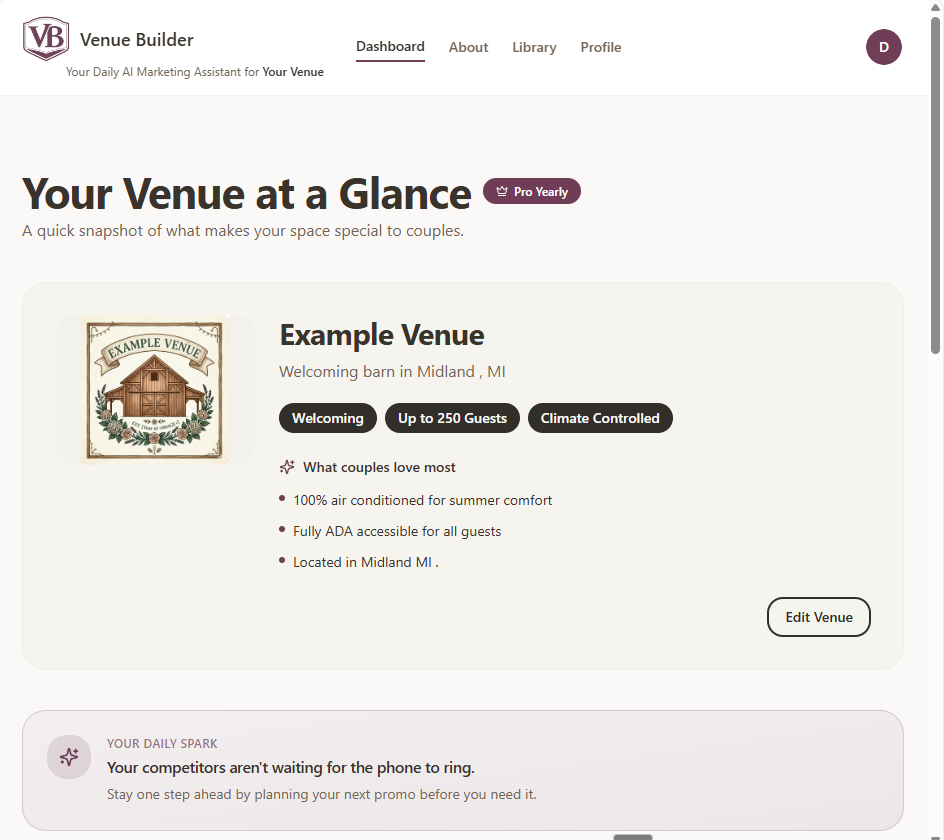
    A screenshot of the Venue Builder dashboard displaying an at-a-glance summary for a sample event venue, showcasing how to track key amenities and location details.

    2. Build a Reciprocal Referral Engine with Vendors

    In the venue industry, your "competitors" are other venues, but your "allies" are the vendors who work within your walls. Florists, caterers, photographers, and DJs are often the first people a client speaks to before they even lock in a space.

    You need to become their favorite venue to work with.

    • Preferred Vendor Lists (The Right Way): Instead of just listing names on a PDF, actively promote your favorite vendors on your social media. Tag them in your photos. When you make them look good, they are motivated to return the favor.
    • The "Vendor Social" Strategy: Once a year, host a "Vendor Open House." Invite local planners and vendors for a free cocktail hour. Let them experience the space without the pressure of an event. When they feel a personal connection to you and your space, your venue becomes the first one they recommend.
    • Data-Driven Partnerships: Use tools like Venue Builder to identify which types of events (corporate vs. community) are performing best, and then reach out to vendors who specialize in those niches.

    Screenshot of Venue Builder’s event planning interface showing suggested partners and risk/reward analysis for events.

    3. Leverage Social Proof as a 24/7 Sales Team

    Your marketing copy will never be as persuasive as a testimonial from a happy client. In an industry built on "the vibe" and emotional experiences, social proof is your most valuable currency.

    • The Post-Event Automation: Within 48 hours of an event ending, send a personalized email to the client. Ask for a review specifically on Google. Why? Because Google reviews directly impact your SEO.
    • Repurpose Reviews into Content: Don't let a 5-star review sit on a listing page. Turn it into a high-quality graphic for Instagram or include it in your email signature.
    • Video Testimonials: A 30-second clip of a bride or a corporate CEO saying, "This was the best experience of my life," is worth 100 static posts. According to recent data, video content generates 12x more engagement for venue marketing than text-based posts.

    4. Master Social Media Without the Time Sink

    Many venue owners feel like they are shouting into a void on social media. The secret is not to post more, but to post smarter.

    Stop focusing on "likes" and start focusing on "discovery."

    • Instagram Reels are Non-Negotiable: Reels are the only way to reach people who don't already follow you. Focus on "transformation" videos: show an empty room being set up for a 200-person gala.
    • Facebook Groups: Join local community and wedding planning groups. Do not spam your links. Instead, answer questions. When someone asks for a "rustic venue with a view," mention your space and offer a free tour.
    • Educational Content: Position yourself as the expert. Share venue marketing ideas or "3 things to ask before booking a ballroom." This builds trust before they ever enquire.

    Pro Tip: Use the Social Builder tool within Venue Builder to quickly generate a month’s worth of high-impact posts tailored to your specific audience (weddings, corporate, or community).

    Screenshot of Venue Builder’s Social Builder tool showing audience setup for Facebook, Instagram, and TikTok.

    5. Mine the "Gold Mine": Your Email List

    The most expensive lead is a new one. The cheapest lead is one you already have. Most venues have hundreds of "lost" inquiries, people who asked for a quote six months ago but never booked.

    • The Check-In Campaign: Send a "soft" check-in email to inquiries from the last 12 months. "We noticed you were interested in our space last year, we've just updated our wedding packages and wanted to see if you're planning any upcoming events."
    • The Corporate Retention Strategy: Corporate clients are the holy grail because they repeat. Email marketing is the #1 driver of returning corporate clients for venues. Send them seasonal reminders for holiday parties or quarterly meetings.
    • Benchmarks: Aim for a 25% open rate. If you aren't hitting that, your subject lines are likely too "salesy." Focus on being helpful, not promotional.

    6. Repurposing Content: Work Once, Use Five Times

    You don't need to be a full-time content creator. You need to be a "content recycler." One professional photo shoot of your venue can be turned into:

    1. A hero image on your website.
    2. A Google Business Profile update.
    3. An Instagram carousel.
    4. A header for your email newsletter.
    5. A background for a "Preferred Vendor" graphic.

    This "work smarter" approach is essential for venue managers who are already wearing too many hats. By filling empty wedding dates through strategic repurposing, you maximize the ROI of every asset you own.

    7. Local Networking and "Feet on the Street"

    In the digital age, we often forget the power of a handshake.

    • Local Chamber of Commerce: Be the venue that hosts the local mixer. Even if you don't charge for the space once or twice a year, the exposure to local business owners is invaluable.
    • Charity Events: Offering your space at a discount (or for free during a slow Tuesday) for a local non-profit gala gets hundreds of high-net-worth individuals into your building. Treat them like a full-paying client; they may be your next corporate booking.

    Unlock Your Venue’s Potential with Venue Builder

    Marketing your venue doesn't have to be a full-time job, and it certainly shouldn't require a massive ad budget. The strategies listed above, SEO, vendor partnerships, social proof, and email, are the bedrock of a successful, profitable venue.

    Venue Builder was designed specifically to help you execute these strategies in minutes, not hours. Whether you need to generate high-converting social copy, plan a campaign to fill a sudden opening, or identify new revenue-generating event ideas, our AI-powered assistant is here to guide you.

    Ready to stop paying for ads and start booking more tours?

    Screenshot of the Venue Builder dashboard highlighting the Revenue Builder, Copy Builder, and Social Builder tools.


    Frequently Asked Questions

    Q: How much time should I spend on organic marketing each week?
    A: If you use the right tools, you can manage a robust organic strategy in just 2-3 hours a week. Focus on one "big" task (like a vendor reach-out) and 20 minutes of daily social engagement.

    Q: Is Google Business Profile really more important than Instagram?
    A: For "high-intent" leads (people ready to book now), yes. Instagram is great for inspiration and vetting, but Google is where people go when they are actively searching for a venue in their area.

    Q: Should I list my prices on my website?
    A: Transparency builds trust. You don't have to list a final "to-the-penny" price, but providing a "starting at" range helps qualify leads so you don't waste time on tours for clients who can't afford your space.

    Q: What is the most effective way to get corporate bookings?
    A: Direct email outreach and local networking. Corporate planners value reliability and ease of communication above all else. Show them that you understand their specific needs (AV, catering, logistics).

    Q: Can AI really help with my marketing?
    A: Absolutely. Tools like Venue Builder take the guesswork out of what to write and how to promote your space, allowing you to focus on what you do best: running incredible events.

  • 7 Venue Marketing Mistakes That Are Costing You Bookings (And How to Fix Them)

    7 Venue Marketing Mistakes That Are Costing You Bookings (And How to Fix Them)

    Running a venue is a balancing act of hospitality excellence and logistical precision. But here is the hard truth: you can host the most breathtaking events in the state, but if your marketing engine is leaking, your calendar will always have gaps.

    In my years of consulting for event spaces, from rustic barns to high-end ballrooms, I’ve seen a recurring pattern. Venue owners often focus so much on the "day-of" experience that they neglect the "pre-booking" journey. This neglect isn't just a minor oversight; it is a direct drain on your bottom line.

    If you aren't seeing the booking volume you expect, you are likely making one (or all) of these seven critical marketing mistakes. Here is how to identify them, the data behind why they matter, and the prescriptive steps to fix them immediately.


    1. Relying Solely on Word-of-Mouth (The "Passive" Trap)

    For decades, the local social club or family-owned estate could survive on reputation alone. Today, that is a dangerous gamble. While word-of-mouth is high-conversion, it is unscalable and unpredictable.

    When you rely only on referrals, you are essentially letting your customers dictate your growth. Research shows that wedding fair attendance has dropped nearly 40% since 2019, and print magazine readership is down by 60%. If you aren't proactive, you are invisible to the modern "digital-first" planner.

    The Fix: Build a Proactive Lead Engine
    Stop waiting for the phone to ring and start generating your own demand. Use tools like the Venue Builder Revenue Builder to identify new audience segments, like corporate retreats or community workshops, and create targeted campaigns to reach them.

    Pro Tip: Aim for a 70/30 split. 70% of your bookings can come from referrals, but 30% should come from active marketing efforts to ensure a consistent, year-round pipeline.


    2. The Mobile-Dead Website (The 70% Bounce)

    Did you know that over 70% of couples and event planners browse venues on their smartphones first? If your website takes more than three seconds to load, or if a user has to "pinch and zoom" to read your capacity chart, you have already lost them.

    A non-responsive website isn't just a nuisance; it’s a red flag. It tells a prospective client that your business isn't modern or detail-oriented.

    The Fix: Optimize for the "Thumb" Experience
    Test your site on multiple devices. Ensure your "Book a Tour" button is large, easy to tap, and visible without scrolling. If your current site is a clunker, consider a simple, high-speed landing page that highlights your best photos and has a direct inquiry form.


    3. Ignoring Your Google Business Profile (The Local Ghost)

    When someone searches for "event spaces near me," Google doesn't just show websites, it shows the Map Pack. If you haven't claimed your Google Business Profile, or if your profile has two blurry photos from 2018, you are handing bookings to your competitors.

    The Fix: Claim, Complete, and Cultivate

    1. Claim your profile: It's free and essential for SEO.
    2. Update your photos: Upload at least 10 high-resolution shots of your space (empty and styled).
    3. Respond to every review: Even the bad ones. It shows you are an active, engaged owner.

    4. Posting Generic "Vanilla" Social Content

    "We host weddings!" is not a marketing strategy. Organic reach on social media is now typically under 5%. If you are just posting the same staged photos everyone else is using, you are white noise in a crowded feed.

    Venue Builder Social Builder interface showing audience and platform selection

    The Fix: Transition from "Posting" to "Storytelling"
    People don't book a venue; they book a feeling. Use the Venue Builder Social Builder to create content that highlights specific stories. Don't just show a table setting; show the behind-the-scenes chaos of a successful setup or a video testimonial from a happy couple.

    Key Strategy: Use the "Rule of Three." For every three posts, one should be educational (tips for planners), one should be emotional (a real wedding story), and one should be promotional (a limited-time offer for an open date).


    5. The "Black Hole" Lead Follow-up

    This is the single biggest revenue killer in the industry. Data suggests that if you take more than 48 hours to respond to an inquiry, the chance of that lead booking drops by nearly 80%. In the age of instant gratification, a "response within 2-3 business days" is an invitation for your lead to keep shopping.

    Venue Builder interface showing marketing post drafts and ticket urgency messaging

    The Fix: The 2-Hour Rule
    Your goal should be an initial response within two hours during business hours. Use automation to send an immediate "I received your inquiry, here is our brochure" email. This buys you time to follow up personally while keeping the lead warm.

    Venue Builder’s Copy Builder can help you draft these high-conversion response templates so you never have to "start from scratch" when a lead hits your inbox.


    6. Neglecting Your Inbox (The Missing Nurture)

    Most venues send one email with a PDF brochure and never follow up again. If the client doesn't book a tour immediately, they are forgotten. This is a massive mistake. Often, a "no" today is just a "not yet."

    The Fix: The 5-Touch Sequence
    Create a simple email nurture sequence for everyone who inquires:

    • Day 1: The Brochure & Introduction.
    • Day 3: A "Look Inside" video or virtual tour.
    • Day 7: A testimonial from a similar event type.
    • Day 14: An FAQ list answering common concerns.
    • Day 30: A check-in to see if they’ve found their dream space yet.

    7. Failing to Showcase Versatility (The "One-Trick Pony")

    If your marketing only shows weddings, corporate planners will assume you can't handle a seminar. If you only show parties, couples will think you aren't "bridal" enough. By not showcasing the versatility of your space, you are artificially shrinking your market.

    Revenue Builder tool interface for selecting target audiences like weddings, corporate, and community groups

    The Fix: Market the "Use-Case," Not the Walls
    Stop selling the "room" and start selling the "transformation." Use the Revenue Builder to generate ideas for off-peak dates. Create separate landing pages or social media highlights for different event types: "Corporate Retreats," "Micro-Weddings," and "Community Galas." Show that your venue is a blank canvas for any vision.


    Conclusion: Stop Guessing, Start Growing

    Marketing doesn't have to be a dark art. Most "failed" marketing is simply a lack of consistency and a failure to address modern consumer behavior. By fixing these seven mistakes, you aren't just "doing marketing": you are building a sustainable, high-revenue business.

    At Venue Builder, we built our platform specifically to help you bridge these gaps without needing a marketing degree. Whether you need to generate new event ideas or draft social posts that actually convert, we’ve got your back.

    Venue Builder dashboard displaying Revenue Builder, Copy Builder, and Social Builder tools

    Ready to stop losing bookings? Get started with Venue Builder today.


    FAQ: Frequently Asked Questions

    How much should I spend on venue marketing?

    Most successful venues allocate 5-10% of their gross revenue to marketing. However, with AI tools like Venue Builder, you can significantly reduce your "man-hours" cost, allowing that budget to go further in paid ads or better photography.

    Should I put my pricing on my website?

    Yes. Statistics show that venues with transparent pricing or "starting at" ranges see 60-70% more qualified inquiries. Hiding your price just leads to more "tire-kickers" wasting your time on tours they can't afford.

    How often should I post on social media?

    Quality beats quantity. Aim for 3-4 high-quality, story-driven posts per week rather than daily "fluff." Consistency is more important than frequency.

    What is the best way to get more reviews?

    The best time to ask for a review is 48 hours after the event ends, while the "high" is still fresh. Send a direct link to your Google Business Profile via email or text.

  • Beyond the Bride: How to Market Your Venue to Corporate, Community, and Social Clients

    Beyond the Bride: How to Market Your Venue to Corporate, Community, and Social Clients

    If you are like most venue owners, your calendar is a game of two halves. Your Saturdays are likely booked out eighteen months in advance with white dresses and tiered cakes. But what about your Tuesdays? What about your Wednesday mornings or your Thursday nights?

    Relying solely on weddings is a high-risk strategy that leaves 80% of your calendar: and your revenue potential: untapped. In the modern event landscape, the most successful venues aren't just "wedding venues"; they are versatile event destinations.

    The data is clear: The U.S. event management market was valued at approximately $285.18 billion in 2024 and is projected to skyrocket to over $471 billion by 2033. While weddings are a massive part of that, corporate and community events are the engines that drive year-round profitability. In fact, many high-performing venues now report that 50% of their annual revenue comes from non-wedding bookings.

    If you are ready to stop leaving money on the table and start filling those "dark" dates, it’s time to pivot your marketing strategy. Here is your expert guide to unlocking the corporate, community, and social markets.


    The Corporate Powerhouse: Marketing for ROI and Efficiency

    Corporate clients aren't looking for "the vibe" in the same way a couple is. They are looking for solutions. When a marketing manager or HR director looks for a venue for a holiday party, team offsite, or product launch, they are balancing a budget and a list of logistical requirements.

    Corporate events represent a goldmine because they often happen during the week and lead to recurring annual business.

    How to Position Your Venue for Corporate Success

    • Highlight the "Boring" Necessities: Corporate planners care about high-speed Wi-Fi, AV capabilities, parking, and proximity to hotels. If you have fiber-optic internet and a built-in projector, lead with that.
    • Focus on Professionalism, Not Romance: Your website copy for weddings might use words like "whimsical" and "eternal." For corporate, swap those for "seamless," "productive," and "strategic."
    • Offer All-Inclusive "Day Rates": Create a package that includes the space, coffee service, lunch catering, and AV setup for a flat per-head fee. This makes it incredibly easy for a busy office manager to hit "book."

    Pro Tip: Events have become the second-largest marketing expenditure for companies, with about 14% of total marketing budgets allocated to them. Position your venue as a partner that helps them achieve their brand goals, not just a room for rent.


    The Heart of the Community: Fundraisers, Galas, and Nonprofits

    Community events: think local school fundraisers, nonprofit galas, and civic group meetings: are the secret to high-volume, high-reputation business. These clients are often looking for spaces that can handle large crowds and offer a sense of prestige or community connection.

    An elegant community fundraiser gala in a modern industrial loft venue

    Strategies for Community Bookings

    • The "Legacy" Angle: Nonprofits want their donors to feel like they are part of something special. Emphasize how your venue’s history or unique architecture adds gravity to their cause.
    • Tiered Pricing for Nonprofits: Offer a "Community Rate" for registered 501(c)(3) organizations on off-peak days. You’ll fill a date that would otherwise be empty, and you’ll get your venue in front of hundreds of local donors: many of whom may be looking for a wedding or corporate venue later.
    • Collaborative Marketing: When you host a community event, leverage their mailing list. Ask to be featured in their event program or newsletter as a "Community Partner."

    Key Strategy: Nearly 70% of Americans prefer attending events close to home. If you aren't the "go-to" spot for your local chamber of commerce or regional charities, you are ignoring your most immediate market.


    Social Celebrations: Beyond the Big "I Do"

    Don't overlook the "social" segment: 50th-anniversary parties, milestone birthdays, bar/bat mitzvahs, and graduation celebrations. These events often mirror weddings in their need for aesthetics and service but carry far less pressure and shorter booking leads.

    Attracting the Social Client

    • Leverage "Micro-Event" Trends: Since 2024, there has been a significant shift toward smaller, more experiential gatherings. Create a "Social Soiree" package specifically for groups of 30-50 people.
    • Update Your Visuals: If your Instagram is 100% bridal, a father planning his daughter’s graduation party will feel like he doesn’t belong there. Post "social proof" of birthday parties and anniversaries.
    • Fast Response Times: Social clients often plan on shorter timelines than couples. If you can respond to an inquiry within 2 hours, you are 50% more likely to win the booking.

    The Digital Facelift: Updating Your Online Presence

    You cannot catch different fish with the same bait. To attract corporate and social clients, your digital footprint needs to reflect your versatility.

    1. Targeted Landing Pages

    Do not just have a "Gallery" page. Create specific landing pages for:

    Each page should feature photos and testimonials specific to that niche.

    2. Strategic SEO

    Stop trying to only rank for "wedding venue near me." Start targeting keywords like "corporate holiday party venue [Your City]" or "private room for anniversary party." This pulls in traffic that is actively looking to spend money on non-wedding dates.

    3. Leverage AI Marketing Tools

    Diversifying your marketing sounds like a lot of work, but it doesn't have to be. Tools like Venue Builder are designed to help you generate this content in minutes rather than hours.

    Venue Builder Dashboard showing venue management and promotional tips


    Using Venue Builder to Fuel Your Expansion

    If the idea of writing different copy for corporate clients and socialites feels overwhelming, this is where Venue Builder becomes your most valuable employee. Instead of staring at a blank screen, you can use the platform to generate targeted marketing ideas and content strategies.

    How to Leverage the Platform:

    • Revenue Builder: Use this to identify which dates are consistently empty and let the AI suggest event types (like "Rustic Cinema & S'mores Night" or "Executive Leadership Offsite") that fit your specific venue type.
    • Copy Builder: Instantly generate professional, ROI-focused captions for LinkedIn to attract corporate planners, while keeping your Instagram "vibe" perfect for social clients.
    • Social Builder: Set your target audience to "Corporate" or "Community" to get a pre-designed 4-day campaign aimed at filling those specific needs.

    Venue Builder Revenue Builder tool for selecting corporate and community audiences

    By selecting the right audience in the Revenue Builder, you ensure that every piece of marketing you put out is hitting the right pain points for that specific client.


    The Efficiency Mandate: Working Smarter, Not Harder

    The modern venue owner is no longer just a "host": you are a marketing strategist. To survive and thrive, you must maximize the utility of your physical asset. Every day your doors are closed is a day of lost revenue.

    Venue Builder Copy Builder interface showing segmentation for various marketing requirements

    By diversifying into corporate, community, and social sectors, you create a "recession-proof" business. When wedding trends shift, your corporate bookings keep you stable. When the economy tightens, your local community fundraisers keep your name prominent.

    Stop being a Saturday-only business. Start being a 365-day destination.


    Frequently Asked Questions

    1. Will marketing to corporate clients hurt my "luxury" wedding brand?

    Not if you do it correctly. By using targeted landing pages, you can present a corporate face to businesses and a romantic face to couples. Your brand is "Excellence in Events," which applies to both.

    2. What is the fastest way to get corporate bookings?

    Local networking and LinkedIn. Use Venue Builder to draft a professional outreach email and send it to the HR directors of the top 20 employers in your 10-mile radius.

    3. Do I need different furniture for corporate events?

    Not necessarily. Many corporate planners love the "unique aesthetic" of wedding venues. Often, all you need is a clean layout, a few extra power strips, and a designated "quiet zone" for phone calls.

    4. How do I price non-wedding events?

    Corporate and social events usually have smaller budgets than weddings but involve much less work for your staff. Consider an hourly rate or a "half-day" rate to stay competitive while maintaining a high margin.

    5. Can I really use AI to manage all this?

    Yes. AI tools like Venue Builder are built specifically for the venue industry. They guide you through simple questions so you can generate powerful results without needing to be a marketing expert.